Product Spec Writer
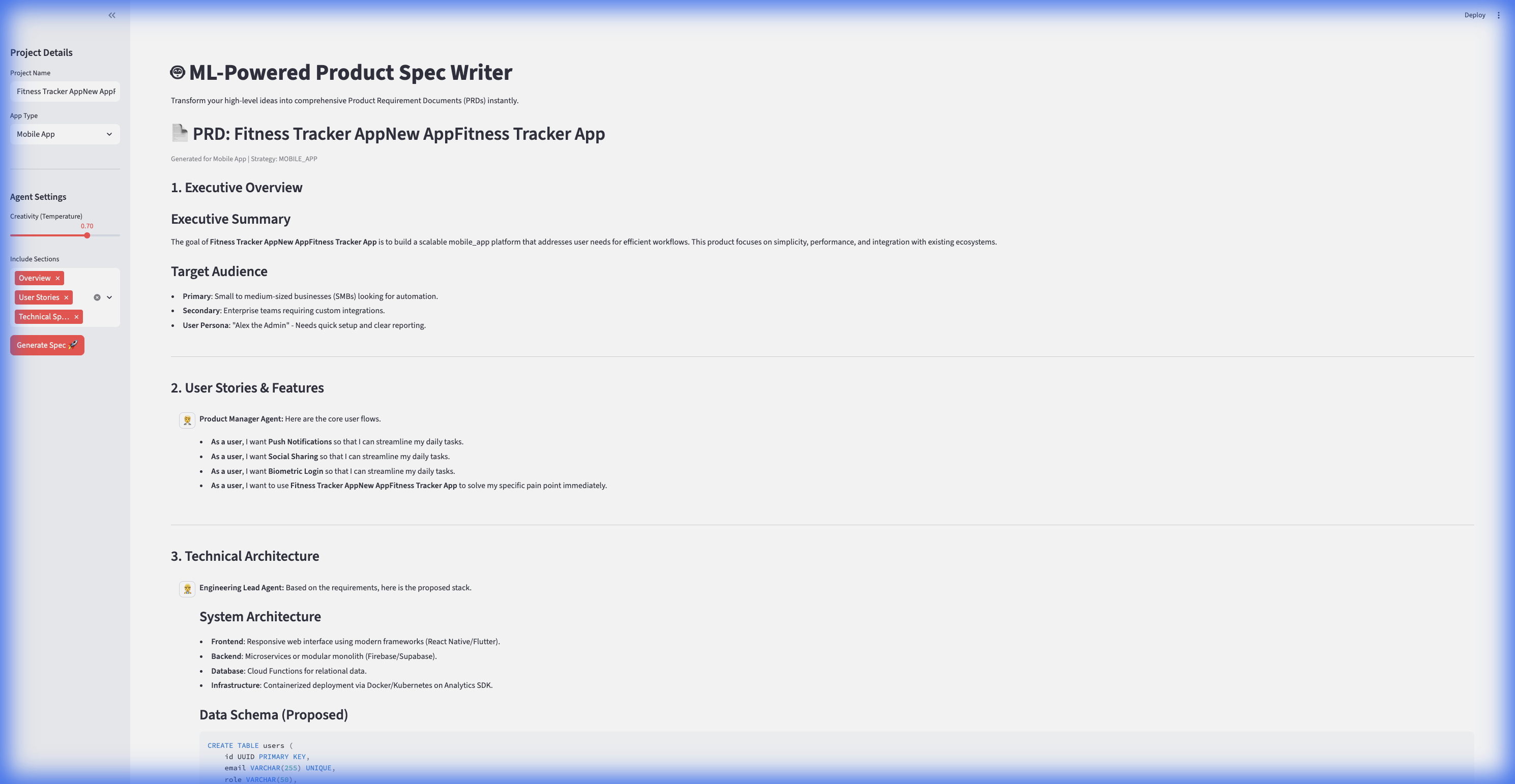
An intelligent agent that transforms high-level product ideas into comprehensive Product Requirement Documents (PRDs), User Stories, and Engineering Schemas.
The Challenge
Writing a thorough Product Requirements Document takes a senior PM 2–4 days of focused work. The process demands fluency in two very different languages simultaneously: the business language of user goals and acceptance criteria, and the engineering language of database schemas and technical risk. Most PMs are strong in one and need support in the other, which means specs regularly ship with gaps that only surface after a sprint has started — costing weeks of rework and team frustration.
The Solution
Two specialized AI agent personas work in sequence on the same input. You describe the feature or product in plain language. The Product Manager Agent handles the "why and what" — drafting user personas, user stories in the standard format, and measurable acceptance criteria. The Engineering Lead Agent then takes the same brief and produces the "how" — a recommended tech stack with rationale, an initial database schema in SQL, and a prioritized list of technical risks to address before sprint 1.
Key Capabilities
- 👤 User Persona Generation Produces 2–3 distinct user archetypes for the feature with goals, pain points, and behavioral context — grounding every subsequent story in a real-world user need.
- 📋 User Stories & Acceptance Criteria Generates a full backlog of stories in "As a… I want… So that…" format, each with specific, testable acceptance criteria — ready to paste directly into Jira or Linear.
- 🗄️ Database Schema Design The Engineering Lead Agent proposes a normalized SQL schema with tables, columns, and relationships — a concrete starting point for the backend team to refine rather than build from scratch.
- 🛠️ Tech Stack Recommendation Suggests a technology stack with tradeoff rationale — weighing build speed, scalability requirements, and team familiarity — so architecture decisions are documented alongside the spec.
- ⚠️ Technical Risk Register Surfaces integration risks, edge cases, and scalability concerns upfront — the questions engineering will ask during sprint planning, answered before the meeting starts.
Tech Stack
- Streamlit
- LangChain / LLMs
- Structured Output Parsers
- Docker / Cloud Run
Patterns Used:
Business Value
A single sprint of rework from an under-specified feature costs 2–3 weeks of engineering time. This agent compresses spec drafting from days to minutes and surfaces technical gaps before engineering starts — making it a force multiplier for any PM managing multiple features simultaneously.
Who this is built for
Product teams, startup founders, and agencies who need to move from idea to engineering-ready spec without burning a sprint on documentation.
Try it live
Type a product feature description in plain English — try "a user login system with social auth", "a recurring billing module", or "a real-time inventory dashboard". The PM Agent and Engineering Lead Agent work in sequence to produce a complete PRD with stories, schema, and risk register. No login required.
Launch Live Demo →Ship features that are actually ready to build
The demo above is the working tool. If you want a version customized to your stack, your backlog tool (Jira, Linear, Notion), and your team's specific standards — let's build it.